Tuesday, June 23, 2009

FORTRAN programming language


The invention: The first major computer programming language,
FORTRAN supported programming in a mathematical language
that was natural to scientists and engineers and achieved unsurpassed
success in scientific computation.
The people behind the invention:
John Backus (1924- ), an American software engineer and
manager
John W. Mauchly (1907-1980), an American physicist and
engineer
Herman Heine Goldstine (1913- ), a mathematician and
computer scientist
John von Neumann (1903-1957), a Hungarian American
mathematician and physicist
Talking to Machines
Formula Translation, or FORTRAN—the first widely accepted
high-level computer language—was completed by John Backus
and his coworkers at the International Business Machines (IBM)
Corporation in April, 1957. Designed to support programming
in a mathematical language that was natural to scientists and engineers,
FORTRAN achieved unsurpassed success in scientific
computation.
Computer languages are means of specifying the instructions
that a computer should execute and the order of those instructions.
Computer languages can be divided into categories of progressively
higher degrees of abstraction. At the lowest level is binary
code, or machine code: Binary digits, or “bits,” specify in
complete detail every instruction that the machine will execute.
This was the only language available in the early days of computers,
when such machines as the ENIAC (Electronic Numerical Integrator
and Calculator) required hand-operated switches and
plugboard connections. All higher levels of language are implemented by having a program translate instructions written in the
higher language into binary machine language (also called “object
code”). High-level languages (also called “programming languages”)
are largely or entirely independent of the underlying
machine structure. FORTRAN was the first language of this type
to win widespread acceptance.
The emergence of machine-independent programming languages
was a gradual process that spanned the first decade of electronic
computation. One of the earliest developments was the invention of
“flowcharts,” or “flow diagrams,” by Herman Heine Goldstine and
John von Neumann in 1947. Flowcharting became the most influential
software methodology during the first twenty years of
computing.
Short Code was the first language to be implemented that contained
some high-level features, such as the ability to use mathematical
equations. The idea came from JohnW. Mauchly, and it was
implemented on the BINAC (Binary Automatic Computer) in 1949
with an “interpreter”; later, it was carried over to the UNIVAC (Universal
Automatic Computer) I. Interpreters are programs that do
not translate commands into a series of object-code instructions; instead,
they directly execute (interpret) those commands. Every time
the interpreter encounters a command, that command must be interpreted
again. “Compilers,” however, convert the entire command
into object code before it is executed.
Much early effort went into creating ways to handle commonly
encountered problems—particularly scientific mathematical
calculations. A number of interpretive languages arose to
support these features. As long as such complex operations had
to be performed by software (computer programs), however, scientific
computation would be relatively slow. Therefore, Backus
lobbied successfully for a direct hardware implementation of these
operations on IBM’s new scientific computer, the 704. Backus then
started the Programming Research Group at IBM in order to develop
a compiler that would allow programs to be written in a
mathematically oriented language rather than a machine-oriented
language. In November of 1954, the group defined an initial version
of FORTRAN.A More Accessible Language
Before FORTRAN was developed, a computer had to perform a
whole series of tasks to make certain types of mathematical calculations.
FORTRAN made it possible for the same calculations to be
performed much more easily. In general, FORTRAN supported constructs
with which scientists were already acquainted, such as functions
and multidimensional arrays. In defining a powerful notation
that was accessible to scientists and engineers, FORTRAN opened
up programming to a much wider community.
Backus’s success in getting the IBM 704’s hardware to support
scientific computation directly, however, posed a major challenge:
Because such computation would be much faster, the object code
produced by FORTRAN would also have to be much faster. The
lower-level compilers preceding FORTRAN produced programs
that were usually five to ten times slower than their hand-coded
counterparts; therefore, efficiency became the primary design objective
for Backus. The highly publicized claims for FORTRAN met
with widespread skepticism among programmers. Much of the
team’s efforts, therefore, went into discovering ways to produce the
most efficient object code.
The efficiency of the compiler produced by Backus, combined
with its clarity and ease of use, guaranteed the system’s success. By
1959, many IBM 704 users programmed exclusively in FORTRAN.
By 1963, virtually every computer manufacturer either had delivered
or had promised a version of FORTRAN.
Incompatibilities among manufacturers were minimized by the
popularity of IBM’s version of FORTRAN; every company wanted
to be able to support IBM programs on its own equipment. Nevertheless,
there was sufficient interest in obtaining a standard for
FORTRAN that the American National Standards Institute adopted
a formal standard for it in 1966. Arevised standard was adopted in
1978, yielding FORTRAN 77.
Consequences
In demonstrating the feasibility of efficient high-level languages,
FORTRAN inaugurated a period of great proliferation of programming languages. Most of these languages attempted to provide similar
or better high-level programming constructs oriented toward a
different, nonscientific programming environment. COBOL, for example,
stands for “Common Business Oriented Language.”
FORTRAN, while remaining the dominant language for scientific
programming, has not found general acceptance among nonscientists.
An IBM project established in 1963 to extend FORTRAN
found the task too unwieldy and instead ended up producing an entirely
different language, PL/I, which was delivered in 1966. In the
beginning, Backus and his coworkers believed that their revolutionary
language would virtually eliminate the burdens of coding and
debugging. Instead, FORTRAN launched software as a field of
study and an industry in its own right.
In addition to stimulating the introduction of new languages,
FORTRAN encouraged the development of operating systems. Programming
languages had already grown into simple operating systems
called “monitors.” Operating systems since then have been
greatly improved so that they support, for example, simultaneously
active programs (multiprogramming) and the networking (combining)
of multiple computers.

Sunday, June 21, 2009

Food freezing


The invention: It was long known that low temperatures helped to
protect food against spoiling; the invention that made frozen
food practical was a method of freezing items quickly. Clarence
Birdseye’s quick-freezing technique made possible a revolution
in food preparation, storage, and distribution.
The people behind the invention:
Clarence Birdseye (1886-1956), a scientist and inventor
Donald K. Tressler (1894-1981), a researcher at Cornell
University
Amanda Theodosia Jones (1835-1914), a food-preservation
pioneer
Feeding the Family
In 1917, Clarence Birdseye developed a means of quick-freezing
meat, fish, vegetables, and fruit without substantially changing
their original taste. His system of freezing was called by Fortune
magazine “one of the most exciting and revolutionary ideas in the
history of food.” Birdseye went on to refine and perfect his method
and to promote the frozen foods industry until it became a commercial
success nationwide.
It was during a trip to Labrador, where he worked as a fur trader,
that Birdseye was inspired by this idea. Birdseye’s new wife and
five-week-old baby had accompanied him there. In order to keep
his family well fed, he placed barrels of fresh cabbages in salt water
and then exposed the vegetables to freezing winds. Successful at
preserving vegetables, he went on to freeze a winter’s supply of
ducks, caribou, and rabbit meat.
In the following years, Birdseye experimented with many freezing
techniques. His equipment was crude: an electric fan, ice, and salt
water. His earliest experiments were on fish and rabbits, which he
froze and packed in old candy boxes. By 1924, he had borrowed
money against his life insurance and was lucky enough to find three
partners willing to invest in his new General Seafoods Company (later renamed General Foods), located in Gloucester, Massachusetts.
Although it was Birdseye’s genius that put the principles of
quick-freezing to work, he did not actually invent quick-freezing.
The scientific principles involved had been known for some time.
As early as 1842, a patent for freezing fish had been issued in England.
Nevertheless, the commercial exploitation of the freezing
process could not have happened until the end of the 1800’s, when
mechanical refrigeration was invented. Even then, Birdseye had to
overcome major obstacles.
Finding a Niche
By the 1920’s, there still were few mechanical refrigerators in
American homes. It would take years before adequate facilities for
food freezing and retail distribution would be established across the
United States. By the late 1930’s, frozen foods had, indeed, found its
role in commerce but still could not compete with canned or fresh
foods. Birdseye had to work tirelessly to promote the industry, writing
and delivering numerous lectures and articles to advance its
popularity. His efforts were helped by scientific research conducted
at Cornell University by Donald K. Tressler and by C. R. Fellers of
what was then Massachusetts State College. Also, during World
War II (1939-1945), more Americans began to accept the idea: Rationing,
combined with a shortage of canned foods, contributed to
the demand for frozen foods. The armed forces made large purchases
of these items as well.
General Foods was the first to use a system of extremely rapid
freezing of perishable foods in packages. Under the Birdseye system,
fresh foods, such as berries or lobster, were packaged snugly in convenient
square containers. Then, the packages were pressed between
refrigerated metal plates under pressure at 50 degrees below zero.
Two types of freezing machines were used. The “double belt” freezer
consisted of two metal belts that moved through a 15-meter freezing
tunnel, while a special salt solution was sprayed on the surfaces of
the belts. This double-belt freezer was used only in permanent installations
and was soon replaced by the “multiplate” freezer, which was
portable and required only 11.5 square meters of floor space compared
to the double belt’s 152 square meters.The multiplate freezer also made it possible to apply the technique
of quick-freezing to seasonal crops. People were able to transport
these freezers easily from one harvesting field to another,
where they were used to freeze crops such as peas fresh off the vine.
The handy multiplate freezer consisted of an insulated cabinet
equipped with refrigerated metal plates. Stacked one above the
other, these plates were capable of being opened and closed to receive
food products and to compress them with evenly distributed
pressure. Each aluminum plate had internal passages through which
ammonia flowed and expanded at a temperature of -3.8 degrees
Celsius, thus causing the foods to freeze.
A major benefit of the new frozen foods was that their taste and vitamin content were not lost. Ordinarily, when food is frozen
slowly, ice crystals form, which slowly rupture food cells, thus altering
the taste of the food. With quick-freezing, however, the food
looks, tastes, and smells like fresh food. Quick-freezing also cuts
down on bacteria.
Impact
During the months between one food harvest and the next, humankind
requires trillions of pounds of food to survive. In many
parts of the world, an adequate supply of food is available; elsewhere,
much food goes to waste and many go hungry. Methods of
food preservation such as those developed by Birdseye have done
much to help those who cannot obtain proper fresh foods. Preserving
perishable foods also means that they will be available in
greater quantity and variety all year-round. In all parts of the world,
both tropical and arctic delicacies can be eaten in any season of the
year.
With the rise in popularity of frozen “fast” foods, nutritionists
began to study their effect on the human body. Research has shown
that fresh is the most beneficial. In an industrial nation with many
people, the distribution of fresh commodities is, however, difficult.
It may be many decades before scientists know the long-term effects
on generations raised primarily on frozen foods.

FM radio


The invention: A method of broadcasting radio signals by modulating
the frequency, rather than the amplitude, of radio waves,
FM radio greatly improved the quality of sound transmission.
The people behind the invention:
Edwin H. Armstrong (1890-1954), the inventor of FM radio
broadcasting
David Sarnoff (1891-1971), the founder of RCA
An Entirely New System
Because early radio broadcasts used amplitude modulation (AM)
to transmit their sounds, they were subject to a sizable amount of interference
and static. Since goodAMreception relies on the amount
of energy transmitted, energy sources in the atmosphere between
the station and the receiver can distort or weaken the original signal.
This is particularly irritating for the transmission of music.
Edwin H. Armstrong provided a solution to this technological
constraint. A graduate of Columbia University, Armstrong made a
significant contribution to the development of radio with his basic
inventions for circuits for AM receivers. (Indeed, the monies Armstrong
received from his earlier inventions financed the development
of the frequency modulation, or FM, system.) Armstrong was
one among many contributors to AM radio. For FM broadcasting,
however, Armstrong must be ranked as the most important inventor.
During the 1920’s, Armstrong established his own research laboratory
in Alpine, New Jersey, across the Hudson River from New
York City. With a small staff of dedicated assistants, he carried out
research on radio circuitry and systems for nearly three decades. At
that time, Armstrong also began to teach electrical engineering at
Columbia University.
From 1928 to 1933, Armstrong worked diligently at his private
laboratory at Columbia University to construct a working model of
an FM radio broadcasting system. With the primitive limitations
then imposed on the state of vacuum tube technology, a number of Armstrong’s experimental circuits required as many as one hundred
tubes. Between July, 1930, and January, 1933, Armstrong filed
four basic FM patent applications. All were granted simultaneously
on December 26, 1933.
Armstrong sought to perfectFMradio broadcasting, not to offer
radio listeners better musical reception but to create an entirely
new radio broadcasting system. On November 5, 1935, Armstrong
made his first public demonstration of FM broadcasting in New
York City to an audience of radio engineers. An amateur station
based in suburban Yonkers, New York, transmitted these first signals.
The scientific world began to consider the advantages and
disadvantages of Armstrong’s system; other laboratories began to
craft their own FM systems.
Corporate Conniving
Because Armstrong had no desire to become a manufacturer or
broadcaster, he approached David Sarnoff, head of the Radio Corporation
of America (RCA). As the owner of the top manufacturer
of radio sets and the top radio broadcasting network, Sarnoff was
interested in all advances of radio technology. Armstrong first demonstrated
FM radio broadcasting for Sarnoff in December, 1933.
This was followed by visits from RCA engineers, who were sufficiently
impressed to recommend to Sarnoff that the company conduct
field tests of the Armstrong system.
In 1934, Armstrong, with the cooperation of RCA, set up a test
transmitter at the top of the Empire State Building, sharing facilities
with the experimental RCAtelevision transmitter. From 1934 through
1935, tests were conducted using the Empire State facility, to mixed
reactions of RCA’s best engineers. AM radio broadcasting already
had a performance record of nearly two decades. The engineers
wondered if this new technology could replace something that had
worked so well.
This less-than-enthusiastic evaluation fueled the skepticism of
RCA lawyers and salespeople. RCA had too much invested in the
AM system, both as a leading manufacturer and as the dominant
owner of the major radio network of the time, the National Broadcasting
Company (NBC). Sarnoff was in no rush to adopt FM. To change systems would risk the millions of dollars RCAwas making
as America emerged from the Great Depression.
In 1935, Sarnoff advised Armstrong that RCA would cease any
further research and development activity in FM radio broadcasting.
(Still, engineers at RCA laboratories continued to work on FM
to protect the corporate patent position.) Sarnoff declared to the
press that his company would push the frontiers of broadcasting by
concentrating on research and development of radio with pictures,
that is, television. As a tangible sign, Sarnoff ordered that Armstrong’s
FM radio broadcasting tower be removed from the top of
the Empire State Building.
Armstrong was outraged. By the mid-1930’s, the development of
FM radio broadcasting had become a mission for Armstrong. For
the remainder of his life, Armstrong devoted his considerable talents
to the promotion of FM radio broadcasting.
Impact
After the break with Sarnoff, Armstrong proceeded with plans to
develop his own FM operation. Allied with two of RCA’s biggest
manufacturing competitors, Zenith and General Electric, Armstrong
pressed ahead. In June of 1936, at a Federal Communications Commission
(FCC) hearing, Armstrong proclaimed that FM broadcasting
was the only static-free, noise-free, and uniform system—both
day and night—available. He argued, correctly, thatAMradio broadcasting
had none of these qualities.
During World War II (1939-1945), Armstrong gave the military
permission to use FM with no compensation. That patriotic gesture
cost Armstrong millions of dollars when the military soon became
all FM. It did, however, expand interest in FM radio broadcasting.
World War II had provided a field test of equipment and use.
By the 1970’s, FM radio broadcasting had grown tremendously.
By 1972, one in three radio listeners tuned into an FM station some
time during the day. Advertisers began to use FM radio stations to
reach the young and affluent audiences that were turning to FM stations
in greater numbers.
By the late 1970’s, FM radio stations were outnumberingAMstations.
By 1980, nearly half of radio listeners tuned into FM stations on a regular basis. Adecade later, FM radio listening accounted for
more than two-thirds of audience time. Armstrong’s predictions
that listeners would prefer the clear, static-free sounds offered by
FM radio broadcasting had come to pass by the mid-1980’s, nearly
fifty years after Armstrong had commenced his struggle to make
FM radio broadcasting a part of commercial radio.

Fluorescent lighting


lighting
The invention: A form of electrical lighting that uses a glass tube
coated with phosphor that gives off a cool bluish light and emits
ultraviolet radiation.
The people behind the invention:
Vincenzo Cascariolo (1571-1624), an Italian alchemist and
shoemaker
Heinrich Geissler (1814-1879), a German glassblower
Peter Cooper Hewitt (1861-1921), an American electrical
engineer
Celebrating the “Twelve Greatest Inventors”
On the night of November 23, 1936, more than one thousand industrialists,
patent attorneys, and scientists assembled in the main
ballroom of the Mayflower Hotel in Washington, D.C., to celebrate
the one hundredth anniversary of the U.S. Patent Office.Atransport
liner over the city radioed the names chosen by the Patent Office as
America’s “Twelve Greatest Inventors,” and, as the distinguished
group strained to hear those names, “the room was flooded for a
moment by the most brilliant light yet used to illuminate a space
that size.”
Thus did The New York Times summarize the commercial introduction
of the fluorescent lamp. The twelve inventors present were
Thomas Alva Edison, Robert Fulton, Charles Goodyear, Charles
Hall, Elias Howe, Cyrus Hall McCormick, Ottmar Mergenthaler,
Samuel F. B. Morse, George Westinghouse, Wilbur Wright, and Eli
Whitney. There was, however, no name to bear the honor for inventing
fluorescent lighting. That honor is shared by many who participated
in a very long series of discoveries.
The fluorescent lamp operates as a low-pressure, electric discharge
inside a glass tube that contains a droplet of mercury and a
gas, commonly argon. The inside of the glass tube is coated with
fine particles of phosphor. When electricity is applied to the gas, the
mercury gives off a bluish light and emits ultraviolet radiation.When bathed in the strong ultraviolet radiation emitted by the mercury,
the phosphor fluoresces (emits light).
The setting for the introduction of the fluorescent lamp began at
the beginning of the 1600’s, when Vincenzo Cascariolo, an Italian
shoemaker and alchemist, discovered a substance that gave off a
bluish glow in the dark after exposure to strong sunlight. The fluorescent
substance was apparently barium sulfide and was so unusual
for that time and so valuable that its formulation was kept secret
for a long time. Gradually, however, scholars became aware of
the preparation secrets of the substance and studied it and other luminescent
materials.
Further studies in fluorescent lighting were made by the German
physicist Johann Wilhelm Ritter. He observed the luminescence of
phosphors that were exposed to various “exciting” lights. In 1801,
he noted that some phosphors shone brightly when illuminated by
light that the eye could not see (ultraviolet light). Ritter thus discovered
the ultraviolet region of the light spectrum. The use of phosphors
to transform ultraviolet light into visible light was an important
step in the continuing development of the fluorescent lamp.
Further studies in fluorescent lighting were made by the German
physicist Johann Wilhelm Ritter. He observed the luminescence of
phosphors that were exposed to various “exciting” lights. In 1801,
he noted that some phosphors shone brightly when illuminated by
light that the eye could not see (ultraviolet light). Ritter thus discovered
the ultraviolet region of the light spectrum. The use of phosphors
to transform ultraviolet light into visible light was an important
step in the continuing development of the fluorescent lamp.
The British mathematician and physicist Sir George Gabriel Stokes
studied the phenomenon as well. It was he who, in 1852, termed the
afterglow “fluorescence.”
Geissler Tubes
While these advances were being made, other workers were trying
to produce a practical form of electric light. In 1706, the English
physicist Francis Hauksbee devised an electrostatic generator, which
is used to accelerate charged particles to very high levels of electrical
energy. He then connected the device to a glass “jar,” used a vacuum pump to evacuate the jar to a low pressure, and tested his
generator. In so doing, Hauksbee obtained the first human-made
electrical glow discharge by “capturing lightning” in a jar.
In 1854, Heinrich Geissler, a glassblower and apparatus maker,
opened his shop in Bonn, Germany, to make scientific instruments;
in 1855, he produced a vacuum pump that used liquid mercury as
an evacuation fluid. That same year, Geissler made the first gaseous
conduction lamps while working in collaboration with the German
scientist Julius Plücker. Plücker referred to these lamps as “Geissler
tubes.” Geissler was able to create red light with neon gas filling a
lamp and light of nearly all colors by using certain types of gas
within each of the lamps. Thus, both the neon sign business and the
science of spectroscopy were born.
Geissler tubes were studied extensively by a variety of workers.
At the beginning of the twentieth century, the practical American
engineer Peter Cooper Hewitt put these studies to use by marketing
the first low-pressure mercury vapor lamps. The lamps were quite
successful, although they required high voltage for operation, emitted
an eerie blue-green, and shone dimly by comparison with their
eventual successor, the fluorescent lamp. At about the same time,
systematic studies of phosphors had finally begun.
By the 1920’s, a number of investigators had discovered that the
low-pressure mercury vapor discharge marketed by Hewitt was an
extremely efficient method for producing ultraviolet light, if the
mercury and rare gas pressures were properly adjusted. With a
phosphor to convert the ultraviolet light back to visible light, the
Hewitt lamp made an excellent light source.
Impact
The introduction of fluorescent lighting in 1936 presented the
public with a completely new form of lighting that had enormous
advantages of high efficiency, long life, and relatively low cost.
By 1938, production of fluorescent lamps was well under way. By
April, 1938, four sizes of fluorescent lamps in various colors had
been offered to the public and more than two hundred thousand
lamps had been sold.
During 1939 and 1940, two great expositions—the New York World’s Fair and the San Francisco International Exposition—
helped popularize fluorescent lighting. Thousands of tubular fluorescent
lamps formed a great spiral in the “motor display salon,”
the car showroom of the General Motors exhibit at the New York
World’s Fair. Fluorescent lamps lit the Polish Restaurant and hung
in vertical clusters on the flagpoles along theAvenue of the Flags at
the fair, while two-meter-long, upright fluorescent tubes illuminated
buildings at the San Francisco International Exposition.
When the United States entered World War II (1939-1945), the
demand for efficient factory lighting soared. In 1941, more than
twenty-one million fluorescent lamps were sold. Technical advances
continued to improve the fluorescent lamp. By the 1990’s,
this type of lamp supplied most of the world’s artificial lighting.

Saturday, June 20, 2009

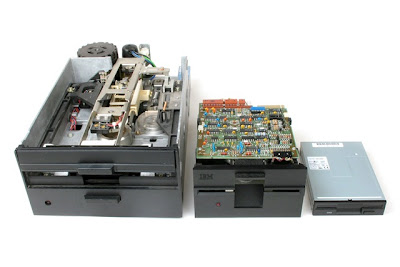
Floppy disk


The invention: Inexpensive magnetic medium for storing and
moving computer data.
The people behind the invention:
Andrew D. Booth (1918- ), an English inventor who
developed paper disks as a storage medium
Reynold B. Johnson (1906-1998), a design engineer at IBM’s
research facility who oversaw development of magnetic disk
storage devices
Alan Shugart (1930- ), an engineer at IBM’s research
laboratory who first developed the floppy disk as a means of
mass storage for mainframe computers
First Tries
When the International Business Machines (IBM) Corporation
decided to concentrate on the development of computers for business
use in the 1950’s, it faced a problem that had troubled the earliest
computer designers: how to store data reliably and inexpensively.
In the early days of computers (the early 1940’s), a number of
ideas were tried. The English inventor Andrew D. Booth produced
spinning paper disks on which he stored data by means of punched
holes, only to abandon the idea because of the insurmountable engineering
problems he foresaw.
The next step was “punched” cards, an idea first used when the
French inventor Joseph-Marie Jacquard invented an automatic weaving
loom for which patterns were stored in pasteboard cards. The
idea was refined by the English mathematician and inventor Charles
Babbage for use in his “analytical engine,” an attempt to build a kind
of computing machine. Although it was simple and reliable, it was
not fast enough, nor did it store enough data, to be truly practical.
The Ampex Corporation demonstrated its first magnetic audiotape
recorder after World War II (1939-1945). Shortly after that, the
Binary Automatic Computer (BINAC) was introduced with a storage
device that appeared to be a large tape recorder. A more advanced machine, the Universal Automatic Computer (UNIVAC),
used metal tape instead of plastic (plastic was easily stretched or
even broken). Unfortunately, metal tape was considerably heavier,
and its edges were razor-sharp and thus dangerous. Improvements
in plastic tape eventually produced sturdy media, and magnetic
tape became (and remains) a practical medium for storage of computer
data.
Still later designs combined Booth’s spinning paper disks with
magnetic technology to produce rapidly rotating “drums.” Whereas
a tape might have to be fast-forwarded nearly to its end to locate a
specific piece of data, a drum rotating at speeds up to 12,500 revolutions
per minute (rpm) could retrieve data very quickly and
could store more than 1 million bits (or approximately 125 kilobytes)
of data.
In May, 1955, these drums evolved, under the direction of Reynold
B. Johnson, into IBM’s hard disk unit. The hard disk unit consisted
of fifty platters, each 2 feet in diameter, rotating at 1,200 rpm. Both
sides of the disk could be used to store information. When the operator
wished to access the disk, at his or her command a read/write
head was moved to the right disk and to the side of the disk that
held the desired data. The operator could then read data from or record
data onto the disk. To speed things even more, the next version
of the device, similar in design, employed one hundred read/write
heads—one for each of its fifty double-sided disks. The only remaining
disadvantage was its size, which earned IBM’s first commercial
unit the nickname “jukebox.”
The First Floppy
The floppy disk drive developed directly from hard disk technology.
It did not take shape until the late 1960’s under the direction of
Alan Shugart (it was announced by IBM as a ready product in 1970).
First created to help restart the operating systems of mainframe
computers that had gone dead, the floppy seemed in some ways to
be a step back, for it operated more slowly than a hard disk drive
and did not store as much data. Initially, it consisted of a single thin
plastic disk eight inches in diameter and was developed without the
protective envelope in which it is now universally encased. The addition of that jacket gave the floppy its single greatest advantage
over the hard disk: portability with reliability.
Another advantage soon became apparent: The floppy is resilient
to damage. In a hard disk drive, the read/write heads must
hover thousandths of a centimeter over the disk surface in order to
attain maximum performance. Should even a small particle of dust
get in the way, or should the drive unit be bumped too hard, the
head may “crash” into the surface of the disk and ruin its magnetic
coating; the result is a permanent loss of data. Because the floppy
operates with the read-write head in contact with the flexible plastic
disk surface, individual particles of dust or other contaminants are
not nearly as likely to cause disaster.
As a result of its advantages, the floppy disk was the logical
choice for mass storage in personal computers (PCs), which were
developed a few years after the floppy disk’s introduction. The
floppy is still an important storage device even though hard disk
drives for PCs have become less expensive. Moreover, manufacturers
continually are developing new floppy formats and new floppy
disks that can hold more data.Consequences
Personal computing would have developed very differently were
it not for the availability of inexpensive floppy disk drives. When
IBM introduced its PC in 1981, the machine provided as standard
equipment a connection for a cassette tape recorder as a storage device;
a floppy disk was only an option (though an option few did not
take). The awkwardness of tape drives—their slow speed and sequential
nature of storing data—presented clear obstacles to the acceptance
of the personal computer as a basic information tool. By
contrast, the floppy drive gives computer users relatively fast storage
at low cost.
Floppy disks provided more than merely economical data storage.
Since they are built to be removable (unlike hard drives), they
represented a basic means of transferring data between machines.
Indeed, prior to the popularization of local area networks (LANs),
the floppy was known as a “sneaker” network: One merely carried
the disk by foot to another computer.
Floppy disks were long the primary means of distributing new
software to users. Even the very flexible floppy showed itself to be
quite resilient to the wear and tear of postal delivery. Later, the 3.5-
inch disk improved upon the design of the original 8-inch and 5.25-
inch floppies by protecting the disk medium within a hard plastic
shell and by using a sliding metal door to protect the area where the
read/write heads contact the disk.
By the late 1990’s, floppy disks were giving way to new datastorage
media, particularly CD-ROMs—durable laser-encoded disks
that hold more than 700 megabytes of data. As the price of blank
CDs dropped dramatically, floppy disks tended to be used mainly
for short-term storage of small amounts of data. Floppy disks were
also being used less and less for data distribution and transfer, as
computer users turned increasingly to sending files via e-mail on
the Internet, and software providers made their products available
for downloading on Web sites.

Friday, June 19, 2009

Field ion microscope


The invention:Amicroscope that uses ions formed in high-voltage
electric fields to view atoms on metal surfaces.
The people behind the invention:
Erwin Wilhelm Müller (1911-1977), a physicist, engineer, and
research professor
J. Robert Oppenheimer (1904-1967), an American physicist
To See Beneath the Surface
In the early twentieth century, developments in physics, especially
quantum mechanics, paved the way for the application of
new theoretical and experimental knowledge to the problem of
viewing the atomic structure of metal surfaces. Of primary importance
were American physicist George Gamow’s 1928 theoretical
explanation of the field emission of electrons by quantum mechanical
means and J. Robert Oppenheimer’s 1928 prediction of the
quantum mechanical ionization of hydrogen in a strong electric
field.
In 1936, ErwinWilhelm Müller developed his field emission microscope,
the first in a series of instruments that would exploit
these developments. It was to be the first instrument to view
atomic structures—although not the individual atoms themselves—
directly. Müller’s subsequent field ion microscope utilized the
same basic concepts used in the field emission microscope yet
proved to be a much more powerful and versatile instrument. By
1956, Müller’s invention allowed him to view the crystal lattice
structure of metals in atomic detail; it actually showed the constituent
atoms.
The field emission and field ion microscopes make it possible to
view the atomic surface structures of metals on fluorescent screens.
The field ion microscope is the direct descendant of the field emission
microscope. In the case of the field emission microscope, the
images are projected by electrons emitted directly from the tip of a
metal needle, which constitutes the specimen under investigation.These electrons produce an image of the atomic lattice structure of
the needle’s surface. The needle serves as the electron-donating
electrode in a vacuum tube, also known as the “cathode.” Afluorescent
screen that serves as the electron-receiving electrode, or “anode,”
is placed opposite the needle. When sufficient electrical voltage
is applied across the cathode and anode, the needle tip emits
electrons, which strike the screen. The image produced on the
screen is a projection of the electron source—the needle surface’s
atomic lattice structure.
Müller studied the effect of needle shape on the performance of
the microscope throughout much of 1937. When the needles had
been properly shaped, Müller was able to realize magnifications of
up to 1 million times. This magnification allowed Müller to view
what he called “maps” of the atomic crystal structure of metals,
since the needles were so small that they were often composed of
only one simple crystal of the material. While the magnification
may have been great, however, the resolution of the instrument was
severely limited by the physics of emitted electrons, which caused
the images Müller obtained to be blurred.
Improving the View
In 1943, while working in Berlin, Müller realized that the resolution
of the field emission microscope was limited by two factors.
The electron velocity, a particle property, was extremely high and
uncontrollably random, causing the micrographic images to be
blurred. In addition, the electrons had an unsatisfactorily high wavelength.
When Müller combined these two factors, he was able to determine
that the field emission microscope could never depict single
atoms; it was a physical impossibility for it to distinguish one
atom from another.
By 1951, this limitation led him to develop the technology behind
the field ion microscope. In 1952, Müller moved to the United States
and founded the Pennsylvania State University Field Emission Laboratory.
He perfected the field ion microscope between 1952 and
1956.
The field ion microscope utilized positive ions instead of electrons
to create the atomic surface images on the fluorescent screen.When an easily ionized gas—at first hydrogen, but usually helium,
neon, or argon—was introduced into the evacuated tube, the emitted
electrons ionized the gas atoms, creating a stream of positively
charged particles, much as Oppenheimer had predicted in 1928.
Müller’s use of positive ions circumvented one of the resolution
problems inherent in the use of imaging electrons. Like the electrons,
however, the positive ions traversed the tube with unpredictably random velocities. Müller eliminated this problem by cryogenically
cooling the needle tip with a supercooled liquefied gas such as
nitrogen or hydrogen.
By 1956, Müller had perfected the means of supplying imaging
positive ions by filling the vacuum tube with an extremely small
quantity of an inert gas such as helium, neon, or argon. By using
such a gas, Müller was assured that no chemical reaction would occur
between the needle tip and the gas; any such reaction would alter
the surface atomic structure of the needle and thus alter the resulting
microscopic image. The imaging ions allowed the field ion
microscope to image the emitter surface to a resolution of between
two and three angstroms, making it ten times more accurate than its
close relative, the field emission microscope.
Consequences
The immediate impact of the field ion microscope was its influence
on the study of metallic surfaces. It is a well-known fact of materials
science that the physical properties of metals are influenced
by the imperfections in their constituent lattice structures. It was not
possible to view the atomic structure of the lattice, and thus the finest
detail of any imperfection, until the field ion microscope was developed.
The field ion microscope is the only instrument powerful
enough to view the structural flaws of metal specimens in atomic
detail.
Although the instrument may be extremely powerful, the extremely
large electrical fields required in the imaging process preclude
the instrument’s application to all but the heartiest of metallic
specimens. The field strength of 500 million volts per centimeter
exerts an average stress on metal specimens in the range of almost
1 ton per square millimeter. Metals such as iron and platinum can
withstand this strain because of the shape of the needles into which
they are formed. Yet this limitation of the instrument makes it extremely
difficult to examine biological materials, which cannot withstand
the amount of stress that metals can. Apractical by-product in
the study of field ionization—field evaporation—eventually permitted
scientists to view large biological molecules.
Field evaporation also allowed surface scientists to view the atomic structures of biological molecules. By embedding molecules
such as phthalocyanine within the metal needle, scientists have
been able to view the atomic structures of large biological molecules
by field evaporating much of the surrounding metal until the biological
material remains at the needle’s surface.

Thursday, June 18, 2009

Fiber-optics


The invention: The application of glass fibers to electronic communications
and other fields to carry large volumes of information
quickly, smoothly, and cheaply over great distances.
The people behind the invention:
Samuel F. B. Morse (1791-1872), the American artist and
inventor who developed the electromagnetic telegraph
system
Alexander Graham Bell (1847-1922), the Scottish American
inventor and educator who invented the telephone and the
photophone
Theodore H. Maiman (1927- ), the American physicist and
engineer who invented the solid-state laser
Charles K. Kao (1933- ), a Chinese-born electrical engineer
Zhores I. Alferov (1930- ), a Russian physicist and
mathematician
The Singing Sun
In 1844, Samuel F. B. Morse, inventor of the telegraph, sent his famous
message, “What hath God wrought?” by electrical impulses
traveling at the speed of light over a 66-kilometer telegraph wire
strung between Washington, D.C., and Baltimore. Ever since that
day, scientists have worked to find faster, less expensive, and more
efficient ways to convey information over great distances.
At first, the telegraph was used to report stock-market prices and
the results of political elections. The telegraph was quite important
in the American Civil War (1861-1865). The first transcontinental
telegraph message was sent by Stephen J. Field, chief justice of the
California Supreme Court, to U.S. president Abraham Lincoln on
October 24, 1861. The message declared that California would remain
loyal to the Union. By 1866, telegraph lines had reached all
across the North American continent and a telegraph cable had
been laid beneath the Atlantic Ocean to link the OldWorld with the
New World.Another American inventor made the leap from the telegraph to
the telephone. Alexander Graham Bell, a teacher of the deaf, was interested
in the physical way speech works. In 1875, he started experimenting
with ways to transmit sound vibrations electrically. He realized
that an electrical current could be adjusted to resemble the vibrations of speech. Bell patented his invention on March 7, 1876.
On July 9, 1877, he founded the Bell Telephone Company.
In 1880, Bell invented a device called the “photophone.” He used
it to demonstrate that speech could be transmitted on a beam of
light. Light is a form of electromagnetic energy. It travels in a vibrating
wave. When the amplitude (height) of the wave is adjusted, a
light beam can be made to carry messages. Bell’s invention included
a thin mirrored disk that converted sound waves directly into a
beam of light. At the receiving end, a selenium resistor connected to
a headphone converted the light back into sound. “I have heard a
ray of sun laugh and cough and sing,” Bell wrote of his invention.
Although Bell proved that he could transmit speech over distances
of several hundred meters with the photophone, the device
was awkward and unreliable, and it never became popular as the
telephone did. Not until one hundred years later did researchers find
important practical uses for Bell’s idea of talking on a beam of light.
Two other major discoveries needed to be made first: developdevelopment
of the laser and of high-purity glass. Theodore H. Maiman, an
American physicist and electrical engineer at Hughes Research Laboratories
in Malibu, California, built the first laser. The laser produces
an intense, narrowly focused beam of light that can be adjusted to
carry huge amounts of information. The word itself is an acronym for
light amplification by the stimulated emission of radiation.
It soon became clear, though, that even bright laser light can be
broken up and absorbed by smog, fog, rain, and snow. So in 1966,
Charles K. Kao, an electrical engineer at the Standard Telecommunications
Laboratories in England, suggested that glass fibers could
be used to transmit message-carrying beams of laser light without
disruption from weather.
Fiber Optics Are Tested
Optical glass fiber is made from common materials, mostly silica,
soda, and lime. The inside of a delicate silica glass tube is coated
with a hundred or more layers of extremely thin glass. The tube is
then heated to 2,000 degrees Celsius and collapsed into a thin glass
rod, or preform. The preform is then pulled into thin strands of fiber.
The fibers are coated with plastic to protect them from being nicked
or scratched, and then they are covered in flexible cable.The earliest glass fibers
contained many impurities
and defects, so they did not
carry light well. Signal repeaters
were needed every
few meters to energize
(amplify) the fading pulses
of light. In 1970, however,
researchers at the Corning
Glass Works in New York
developed a fiber pure
enough to carry light at
least one kilometer without
amplification.
The telephone industry
quickly became involved in the new fiber-optics technology. Researchers
believed that a bundle of optical fibers as thin as a pencil
could carry several hundred telephone calls at the same time. Optical
fibers were first tested by telephone companies in big cities,
where the great volume of calls often overloaded standard underground
phone lines.
On May 11, 1977, American Telephone & Telegraph Company
(AT&T), along with Illinois Bell Telephone, Western Electric, and
Bell Telephone Laboratories, began the first commercial test of fiberoptics
telecommunications in downtown Chicago. The system consisted
of a 2.4-kilometer cable laid beneath city streets. The cable,
only 1.3 centimeters in diameter, linked an office building in the
downtown business district with two telephone exchange centers.
Voice and video signals were coded into pulses of laser light and
transmitted through the hair-thin glass fibers. The tests showed that
a single pair of fibers could carry nearly six hundred telephone conversations
at once very reliably and at a reasonable cost.
Six years later, in October, 1983, Bell Laboratories succeeded in
transmitting the equivalent of six thousand telephone signals through
an optical fiber cable that was 161 kilometers long. Since that time,
countries all over the world, fromEngland to Indonesia, have developed
optical communications systems.Consequences
Fiber optics has had a great impact on telecommunications. Asingle
fiber can now carry thousands of conversations with no electrical
interference. These fibers are less expensive, weigh less, and take up
much less space than copper wire. As a result, people can carry on
conversations over long distances without static and at a low cost.
One of the first uses of fiber optics and perhaps its best-known
application is the fiberscope, a medical instrument that permits internal
examination of the human body without surgery or X-ray
techniques. The fiberscope, or endoscope, consists of two fiber
bundles. One of the fiber bundles transmits bright light into the patient,
while the other conveys a color image back to the eye of the
physician. The fiberscope has been used to look for ulcers, cancer,
and polyps in the stomach, intestine, and esophagus of humans.
Medical instruments, such as forceps, can be attached to the fiberscope,
allowing the physician to perform a range of medical procedures,
such as clearing a blocked windpipe or cutting precancerous
polyps from the colon.