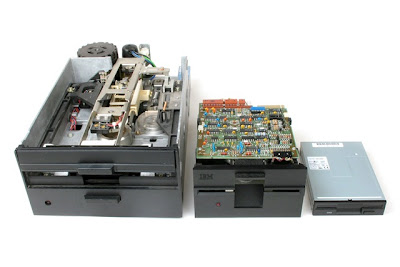
Showing posts with label disk. Show all posts
Thursday, September 24, 2009
Optical disk
The invention:Anonmagnetic storage medium for computers that
can hold much greater quantities of data than similar size magnetic
media, such as hard and floppy disks.
The people behind the invention:
Klaas Compaan, a Dutch physicist
Piet Kramer, head of Philips’ optical research laboratory
Lou F. Ottens, director of product development for Philips’
musical equipment division
George T. de Kruiff, manager of Philips’ audio-product
development department
Joop Sinjou, a Philips project leader
Holograms Can Be Copied Inexpensively
Holography is a lensless photographic method that uses laser
light to produce three-dimensional images. This is done by splitting
a laser beam into two beams. One of the beams
is aimed at the object
whose image is being reproduced so that the laser light will reflect
from the object and strike a photographic plate or film. The second
beam of light is reflected from a mirror near the object and also
strikes the photographic plate or film. The “interference pattern,”
which is simply the pattern created by the differences between the
two reflected beams of light, is recorded on the photographic surface.
The recording that is made in this way is called a “hologram.”
When laser light or white light strikes the hologram, an image is created
that appears to be a three-dimensional object.
Early in 1969, Radio Corporation of America (RCA) engineers
found a way to copy holograms inexpensively by impressing interference
patterns on a nickel sheet that then became a mold from
which copies could be made. Klaas Compaan, a Dutch physicist,
learned of this method and had the idea that images could be recorded
in a similar way and reproduced on a disk the size of a phonograph
record. Once the images were on the disk, they could be
projected onto a screen in any sequence. Compaan saw the possibilities
of such a technology in the fields of training and education.
Computer Data Storage Breakthrough
In 1969, Compaan shared his idea with Piet Kramer, who was the
head of Philips’ optical research laboratory. The idea intrigued
Kramer. Between 1969 and 1971, Compaan spent much of his time
working on the development of a prototype.
By September, 1971, Compaan and Kramer, together with a handful
of others, had assembled a prototype that could read a blackand-
white video signal from a spinning glass disk. Three months
later, they demonstrated it for senior managers at Philips. In July,
1972, a color prototype was demonstrated publicly. After the demonstration,
Philips began to consider putting sound, rather than images,
on the disks. The main attraction of that idea was that the 12-
inch (305-millimeter) disks would hold up to forty-eight hours of
music. Very quickly, however, Lou F. Ottens, director of product development
for Philips’ musical equipment division, put an end to
any talk of a long-playing audio disk.
Ottens had developed the cassette-tape cartridge in the 1960’s.
He had plenty of experience with the recording industry, and he had
no illusions that the industry would embrace that new medium. He
was convinced that the recording companies would consider fortyeight
hours of music unmarketable. He also knew that any new
medium would have to offer a dramatic improvement over existing
vinyl records.
In 1974, only three years after the first microprocessor (the basic
element of computers) was invented, designing a digital consumer
product—rather than an analog product such as those that were already
commonly accepted—was risky. (Digital technology uses
numbers to represent information, whereas analog technology represents
information by mechanical or physical means.) When
George T. de Kruiff became Ottens’s manager of audio-product
development in June, 1974, he was amazed that there were no
digital circuit specialists in the audio department. De Kruiff recruited
new digital engineers, bought computer-aided design
tools, and decided that the project should go digital.
Within a few months, Ottens’s engineers had rigged up a digital
system. They used an audio signal that was representative of an
acoustical wave, sampled it to change it to digital form,
and encoded it as a series of pulses.
On the disk itself, they varied the
length of the “dimples” that were used to represent the sound so
that the rising and falling edges of the series of pulses corresponded
to the dimples’ walls. A helium-neon laser was reflected from
the dimples to photodetectors that were connected to a digital-toanalog
converter.
In 1978, Philips demonstrated a prototype for Polygram (a West
German company) and persuaded Polygram to develop an inexpensive
disk material with the appropriate optical qualities. Most
important was that the material could not warp. Polygram spent
about $150,000 and three months to develop the disk. In addition, it
was determined that the gallium-arsenide (GaAs) laser would be
used in the project. Sharp Corporation agreed to manufacture a
long-life GaAs diode laser to Philips’ specifications.
The optical-system designers wanted to reduce the number
of parts in order to decrease manufacturing costs and improve
reliability. Therefore, the lenses were simplified and considerable
work was devoted to developing an error-correction code.
Philips and Sony engineers also worked together to create a standard
format. In 1983, Philips made almost 100,000 units of optical
disks.
Consequences
In 1983, one of the most successful consumer products of all time
was introduced: the optical-disk system. The overwhelming success
of optical-disk reproduction led to the growth of a multibillion-dollar
industry around optical information and laid the groundwork
for a whole crop of technologies that promise to revolutionize computer
data storage. Common optical-disk products are the compact
disc (CD), the compact disc read-only memory (CD-ROM), the
write-once, read-many (WORM) erasable disk, and CD-I (interactive
CD).
The CD-ROM, the WORM, and the erasable optical disk, all of
which are used in computer applications, can hold more than 550
megabytes, from 200 to 800 megabytes, and 650 megabytes of data,
respectively.
The CD-ROM is a nonerasable disc that is used to store computer
data. After the write-once operation is performed, a WORM becomes
a read-only optical disk. An erasable optical disk can be
erased and rewritten easily. CD-ROMs, coupled with expert-system
technology, are expected to make data retrieval easier. The CD-ROM,
the WORM, and the erasable optical disk may replace magnetic
hard and floppy disks as computer data storage devices.
Thursday, July 9, 2009
Hard disk

The invention: A large-capacity, permanent magnetic storage device
built into most personal computers.
The people behind the invention:
Alan Shugart (1930- ), an engineer who first developed the
floppy disk
Philip D. Estridge (1938?-1985), the director of IBM’s product
development facility
Thomas J. Watson, Jr. (1914-1993), the chief executive officer of
IBM
The Personal Oddity
When the International Business Machines (IBM) Corporation
introduced its first microcomputer, called simply the IBM PC (for
“personal computer”), the occasion was less a dramatic invention
than the confirmation of a trend begun some years before. A number
of companies had introduced microcomputers before IBM; one
of the best known at that time was Apple Corporation’s Apple II, for
which software for business and scientific use was quickly developed.
Nevertheless, the microcomputer was quite expensive and
was often looked upon as an oddity, not as a useful tool.
Under the leadership of Thomas J. Watson, Jr., IBM, which had
previously focused on giant mainframe computers, decided to develop
the PC. A design team headed by Philip D. Estridge was assembled
in Boca Raton, Florida, and it quickly developed its first,
pacesetting product. It is an irony of history that IBM anticipated
selling only one hundred thousand or so of these machines, mostly
to scientists and technically inclined hobbyists. Instead, IBM’s product
sold exceedingly well, and its design parameters, as well as its
operating system, became standards.
The earliest microcomputers used a cassette recorder as a means
of mass storage; a floppy disk drive capable of storing approximately
160 kilobytes of data was initially offered only as an option.
While home hobbyists were accustomed to using a cassette recorder for storage purposes, such a system was far too slow and awkward
for use in business and science. As a result, virtually every IBM PC
sold was equipped with at least one 5.25-inch floppy disk drive.
Memory Requirements
All computers require memory of two sorts in order to carry out
their tasks. One type of memory is main memory, or random access
memory (RAM), which is used by the computer’s central processor
to store data it is using while operating. The type of memory used
for this function is built typically of silicon-based integrated circuits
that have the advantage of speed (to allow the processor to fetch or
store the data quickly), but the disadvantage of possibly losing or
“forgetting” data when the electric current is turned off. Further,
such memory generally is relatively expensive.
To reduce costs, another type of memory—long-term storage
memory, known also as “mass storage”—was developed. Mass
storage devices include magnetic media (tape or disk drives) and
optical media (such as the compact disc, read-only memory, or CDROM).
While the speed with which data may be retrieved from or
stored in such devices is rather slow compared to the central processor’s
speed, a disk drive—the most common form of mass storage
used in PCs—can store relatively large amounts of data quite inexpensively.
Early floppy disk drives (so called because the magnetically
treated material on which data are recorded is made of a very flexible
plastic) held 160 kilobytes of data using only one side of the
magnetically coated disk (about eighty pages of normal, doublespaced,
typewritten information). Later developments increased
storage capacities to 360 kilobytes by using both sides of the disk
and later, with increasing technological ability, 1.44 megabytes (millions
of bytes). In contrast, mainframe computers, which are typically
connected to large and expensive tape drive storage systems,
could store gigabytes (millions of megabytes) of information.
While such capacities seem large, the needs of business and scientific
users soon outstripped available space. Since even the mailing
list of a small business or a scientist’s mathematical model of a
chemical reaction easily could require greater storage potential than early PCs allowed, the need arose for a mass storage device that
could accommodate very large files of data.
The answer was the hard disk drive, also known as a “fixed disk
drive,” reflecting the fact that the disk itself is not only rigid but also
permanently installed inside the machine. In 1955, IBM had envisioned
the notion of a fixed, hard magnetic disk as a means of storing
computer data, and, under the direction of Alan Shugart in the
1960’s, the floppy disk was developed as well.
As the engineers of IBM’s facility in Boca Raton refined the idea
of the original PC to design the new IBM PC XT, it became clear that
chief among the needs of users was the availability of large-capability
storage devices. The decision was made to add a 10-megabyte
hard disk drive to the PC. On March 8, 1983, less than two years after
the introduction of its first PC, IBM introduced the PC XT. Like
the original, it was an evolutionary design, not a revolutionary one.
The inclusion of a hard disk drive, however, signaled that mass storage
devices in personal computers had arrived.
Consequences
Above all else, any computer provides a means for storing, ordering,
analyzing, and presenting information. If the personal computer
is to become the information appliance some have suggested
it will be, the ability to manipulate very large amounts of data will
be of paramount concern. Hard disk technology was greeted enthusiastically
in the marketplace, and the demand for hard drives has
seen their numbers increase as their quality increases and their
prices drop.
It is easy to understand one reason for such eager acceptance:
convenience. Floppy-bound computer users find themselves frequently
changing (or “swapping”) their disks in order to allow programs
to find the data they need. Moreover, there is a limit to how
much data a single floppy disk can hold. The advantage of a hard
drive is that it allows users to keep seemingly unlimited amounts of
data and programs stored in their machines and readily available.
Also, hard disk drives are capable of finding files and transferring
their contents to the processor much more quickly than a
floppy drive. A user may thus create exceedingly large files, keep them on hand at all times, and manipulate data more quickly than
with a floppy. Finally, while a hard drive is a slow substitute for
main memory, it allows users to enjoy the benefits of larger memories
at significantly lower cost.
The introduction of the PC XT with its 10-megabyte hard drive
was a milestone in the development of the PC. Over the next two decades,
the size of computer hard drives increased dramatically. By
2001, few personal computers were sold with hard drives with less
than three gigabytes of storage capacity, and hard drives with more
than thirty gigabytes were becoming the standard. Indeed, for less
money than a PC XT cost in the mid-1980’s, one could buy a fully
equipped computer with a hard drive holding sixty gigabytes—a
storage capacity equivalent to six thousand 10-megabyte hard drives.
Saturday, June 20, 2009
Floppy disk
The invention: Inexpensive magnetic medium for storing and
moving computer data.
The people behind the invention:
Andrew D. Booth (1918- ), an English inventor who
developed paper disks as a storage medium
Reynold B. Johnson (1906-1998), a design engineer at IBM’s
research facility who oversaw development of magnetic disk
storage devices
Alan Shugart (1930- ), an engineer at IBM’s research
laboratory who first developed the floppy disk as a means of
mass storage for mainframe computers
First Tries
When the International Business Machines (IBM) Corporation
decided to concentrate on the development of computers for business
use in the 1950’s, it faced a problem that had troubled the earliest
computer designers: how to store data reliably and inexpensively.
In the early days of computers (the early 1940’s), a number of
ideas were tried. The English inventor Andrew D. Booth produced
spinning paper disks on which he stored data by means of punched
holes, only to abandon the idea because of the insurmountable engineering
problems he foresaw.
The next step was “punched” cards, an idea first used when the
French inventor Joseph-Marie Jacquard invented an automatic weaving
loom for which patterns were stored in pasteboard cards. The
idea was refined by the English mathematician and inventor Charles
Babbage for use in his “analytical engine,” an attempt to build a kind
of computing machine. Although it was simple and reliable, it was
not fast enough, nor did it store enough data, to be truly practical.
The Ampex Corporation demonstrated its first magnetic audiotape
recorder after World War II (1939-1945). Shortly after that, the
Binary Automatic Computer (BINAC) was introduced with a storage
device that appeared to be a large tape recorder. A more advanced machine, the Universal Automatic Computer (UNIVAC),
used metal tape instead of plastic (plastic was easily stretched or
even broken). Unfortunately, metal tape was considerably heavier,
and its edges were razor-sharp and thus dangerous. Improvements
in plastic tape eventually produced sturdy media, and magnetic
tape became (and remains) a practical medium for storage of computer
data.
Still later designs combined Booth’s spinning paper disks with
magnetic technology to produce rapidly rotating “drums.” Whereas
a tape might have to be fast-forwarded nearly to its end to locate a
specific piece of data, a drum rotating at speeds up to 12,500 revolutions
per minute (rpm) could retrieve data very quickly and
could store more than 1 million bits (or approximately 125 kilobytes)
of data.
In May, 1955, these drums evolved, under the direction of Reynold
B. Johnson, into IBM’s hard disk unit. The hard disk unit consisted
of fifty platters, each 2 feet in diameter, rotating at 1,200 rpm. Both
sides of the disk could be used to store information. When the operator
wished to access the disk, at his or her command a read/write
head was moved to the right disk and to the side of the disk that
held the desired data. The operator could then read data from or record
data onto the disk. To speed things even more, the next version
of the device, similar in design, employed one hundred read/write
heads—one for each of its fifty double-sided disks. The only remaining
disadvantage was its size, which earned IBM’s first commercial
unit the nickname “jukebox.”
The First Floppy
The floppy disk drive developed directly from hard disk technology.
It did not take shape until the late 1960’s under the direction of
Alan Shugart (it was announced by IBM as a ready product in 1970).
First created to help restart the operating systems of mainframe
computers that had gone dead, the floppy seemed in some ways to
be a step back, for it operated more slowly than a hard disk drive
and did not store as much data. Initially, it consisted of a single thin
plastic disk eight inches in diameter and was developed without the
protective envelope in which it is now universally encased. The addition of that jacket gave the floppy its single greatest advantage
over the hard disk: portability with reliability.
Another advantage soon became apparent: The floppy is resilient
to damage. In a hard disk drive, the read/write heads must
hover thousandths of a centimeter over the disk surface in order to
attain maximum performance. Should even a small particle of dust
get in the way, or should the drive unit be bumped too hard, the
head may “crash” into the surface of the disk and ruin its magnetic
coating; the result is a permanent loss of data. Because the floppy
operates with the read-write head in contact with the flexible plastic
disk surface, individual particles of dust or other contaminants are
not nearly as likely to cause disaster.
As a result of its advantages, the floppy disk was the logical
choice for mass storage in personal computers (PCs), which were
developed a few years after the floppy disk’s introduction. The
floppy is still an important storage device even though hard disk
drives for PCs have become less expensive. Moreover, manufacturers
continually are developing new floppy formats and new floppy
disks that can hold more data.Consequences
Personal computing would have developed very differently were
it not for the availability of inexpensive floppy disk drives. When
IBM introduced its PC in 1981, the machine provided as standard
equipment a connection for a cassette tape recorder as a storage device;
a floppy disk was only an option (though an option few did not
take). The awkwardness of tape drives—their slow speed and sequential
nature of storing data—presented clear obstacles to the acceptance
of the personal computer as a basic information tool. By
contrast, the floppy drive gives computer users relatively fast storage
at low cost.
Floppy disks provided more than merely economical data storage.
Since they are built to be removable (unlike hard drives), they
represented a basic means of transferring data between machines.
Indeed, prior to the popularization of local area networks (LANs),
the floppy was known as a “sneaker” network: One merely carried
the disk by foot to another computer.
Floppy disks were long the primary means of distributing new
software to users. Even the very flexible floppy showed itself to be
quite resilient to the wear and tear of postal delivery. Later, the 3.5-
inch disk improved upon the design of the original 8-inch and 5.25-
inch floppies by protecting the disk medium within a hard plastic
shell and by using a sliding metal door to protect the area where the
read/write heads contact the disk.
By the late 1990’s, floppy disks were giving way to new datastorage
media, particularly CD-ROMs—durable laser-encoded disks
that hold more than 700 megabytes of data. As the price of blank
CDs dropped dramatically, floppy disks tended to be used mainly
for short-term storage of small amounts of data. Floppy disks were
also being used less and less for data distribution and transfer, as
computer users turned increasingly to sending files via e-mail on
the Internet, and software providers made their products available
for downloading on Web sites.
Subscribe to:
Posts (Atom)